
NICKEL AND ITS ALLOYS

 Although some nickel is obtained commercially from oxide ores, arsenical ores , and the ores of copper, manganese and iron, at least 85 percent of all nickel production is obtained from sulphide ores.

Pure Nickel is tough, silver-colored metal, rather harder than copper, and of about the same strength, but possessing somewhat less ductility. It closely resembles iron in several of its properties, being malleable and weldable, and perceptibly magnetic, but unlike iron it is little affected by dilute acids, is far less readily oxidisable, and deteriorates much less rapidly under atmospheric influences. For this reason articles of iron and steel are frequently nickel - plated  to protect them from rusting. Nickel is much used for cooking utensils, and other vessels for heating and boiling. Nickel enters as a constituent into a large number of ferrous and non ferrous alloys, and frequently finds application as a catalyst in important Industrial processes. 
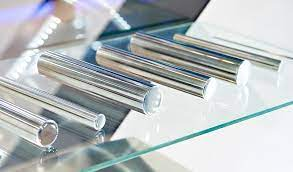

Nickel Alloys which are particularly useful for general industrial purposes are described below :

MONEL METAL :

It is an alloy of 60 per cent nickel , 38 percent copper and a small amount of  aluminum or manganese. 

It is a white, tough and ductile metal and can be readily machined. It welds without difficultly. It can be heat treated. It is also resistant to corrosion by most agents and has high strength at elevated temperatures.

Monel metal is used in the forms of rod, sheet , wire, and welded tubing. It is widely employed for structural and machine parts which must have a very high resistance to corrosion and high strength as steam turbine blade, impeller of centrifugal pump , etc. 

GERMAN SILVER :

An alloy of copper (25 to 50 per cent) , nickel (10 to 35 percent) , and zinc (25 to 35 percent) is known as German Silver. Sometimes, Tin and lead are also added.

It is hard, white and ductile. This is usually of bright silvery color, but may also assume various other pleasing colors by adjusting the proportions of the copper , nickel and zinc. It has in addition to color, good mechanical and corrosion resisting properties. It is also known Ni-Silver. 

German Silver is used for making utensils and resistances in electrical work.   

INCONEL :

It contains 70 to 80 percent nickel, 10 to 15 percent chromium and the rest iron. It can be used for parts that are exposed to high temperature for extended period. It is less reactive than nichrome to acid.

NICHROME :

This is an alloy of nickel with chromium and is used widely as resistance wire for electrical appliances. 

NIMONICS :

A new type of nickel alloy called nimonics are being developed, which by proper heat treatment attain excellent properties for very high temperature service as well as under intermittent heating and cooling conditions. They contain 15 to 18 percent chromium, 15 to 18 per cent cobalt, 3.5 to 5 percent molybdenum, 1.2 to 4.0 per cent titanium, 1.2 to 5.0 percent aluminum , and the remainder nickel. 


Comments

Popular posts from this blog

ELECTRICAL COMPARATORS AND ITS WORKING

Electrical Comparators are used as a means of  detecting and amplifying small movements of a work contacting elements. An electrical comparator consists essentially of  a pick-up head or transducer for converting a displacement into a corresponding change in current and a meter or recorder connected in the circuit to indicate the electrical change, calibrated to show in terms of displacement. Generally, an amplifier is needed to provide the requisite sensitivity and to match the characteristics of different parts of  the circuit. Electrical comparators can be classified according to the electrical principle used in the pick-up head. Most of the comparators use either a differential transformer, an inductance bridge, a strain gauge or a capacitor as a means of detecting movement of the gauging element. There are different types of  electrical comparators. One kind called an electrolimit gauge is used to check or measure the outside diameter of a  roll. The objec...

SIMPLE CARBURETOR - CONSTRUCTION AND WORKING

CONSTRUCTION OF SIMPLE CARBURETOR :  The main Components of Simple Carburetor are : Float Chamber, float, nozzle, venturi, throttle valve, inlet valve, and metering jet . In the float chamber, a constant level of petrol is maintained by the float and a needle valve.  The float chamber is ventilated to atmosphere.  This is used to maintain atmospheric pressure inside the chamber. The float which is normally a metallic hollow cylinder rises and closes the inlet valve as the fuel level in the float chamber increases to certain level. The mixing chamber contains venturi, nozzle and throttle valve. The venturi tube is fitted with the inlet  manifold. This tube has a narrow opening called venturi. A nozzle is provided just below the centre of this venturi. The nozzle keeps the same level of petrol as that of the level in the float chamber. The mixing chamber has two butterfly valves.  One is to allow air into the mixing chamber known as choke valve. The other is to al...

TOP POLLUTION RECORDED IN WORLD

CHERNOBYL NUCLEAR DISASTER (NUCLEAR POLLUTION) :  In April 26,1986, the melt down of the Chernobyl nuclear reactor , in Russia, has leaked out the radioactive rays and radioactive materials.   Effects : 1. In this Pollution nearly 2000 persons have been killed by the accident. 2. People suffered due to the illness such as, degeneration of the cells, severe bleeding, anemia, skin cancer. 3. Animals, Plants are also affected by nuclear radiation.  MINAMATA EPIDEMIC (1953) : MARINE POLLUTION ( CASE STUDY ) Minamata is a small coastal village in Japan. The Chisso Chemical Company , which produces vinyl polymer plastics used organomercurial compound. The industry released its effluent into Minamata sea. The effluent containing mercury ions is converted into methyl mercury, which is highly toxic.  The marine organisms like phytoplankton and zoo-planktons easily absorb the toxic methyl mercury compound. These organisms are consumed by small fishes and these are in ...