
Methods of Lubrication in IC Engine

 The various methods adopted for lubrication Of  I.C Engines are :

i) Petrol lubrication or mist lubrication system,

ii) Wet sump system, and 

iii) Dry sump system. 


I) Petrol or Mist Lubrication System :

   It is simplest of all types of lubrication. This method is used in light vehicles such as motor cycles and scooters. About 3 to 6 % of lubricating oil is mixed with petrol in fuel tank. Here, there is no separate sump and pump. The oil mixing with petrol acts as lubricant. 

The disadvantage of  this method is, if the engine remains idle for the long time, the oil will get separated and cause clogging of fuel passage in carburetor there by resulting in starting trouble. If the quantity of mixing oil is less, lubricating is insufficient which causes damage to the engine. If the quantity of oil is more, it will release more carbon deposits in the cylinder. So, the engine will give dark smoke.


II) Wet Sump System :

   In this method, the lubrication oil is stored in the oil sump. From the oil sump, the oil is supplied to various parts of  the engine. This system may be further classified as :

a) Gravity Lubrication System 

b) Splash Lubrication System

c) Pressure Lubrication System

d) Semi - pressure Lubrication System
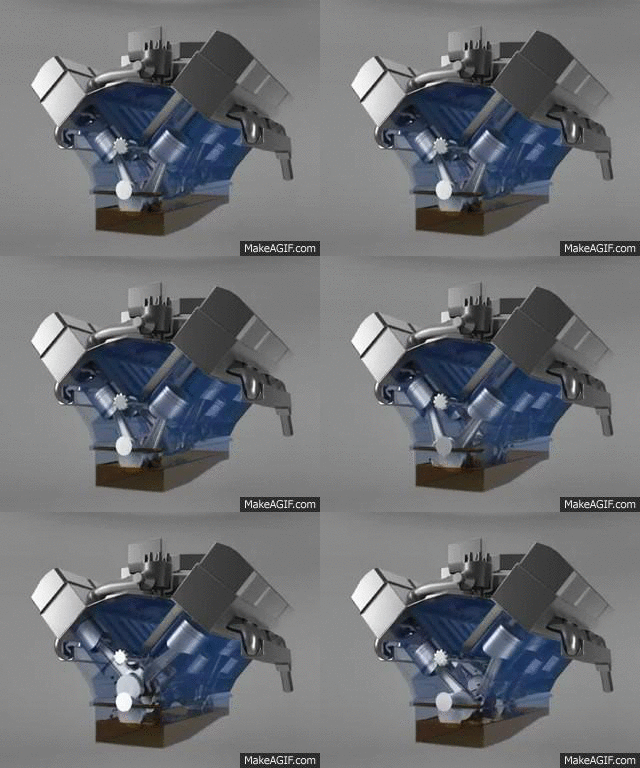


III) Dry Sump Lubrication System :

     The lubricating oil stored in the oil sump is called wet sump system. But the system in which the lubricating oil is not kept in the oil sump is known as dry sump system. In this system, oil is carried in a separate tank and fed to the engine.

     The oil which falls into the oil sump after lubrication is sent back to oil tank by a separate delivery pump. Thus the system consists of two pumps. One pump is used to feed the oil. The other pump is used to deliver the oil to the oil tank. This system is used in aircrafts.

     The main advantage of  this system is that there is no chance of break down in the oil supply during up and down movement of  the vehicle.    

Comments

Popular posts from this blog

ELECTRICAL COMPARATORS AND ITS WORKING

Electrical Comparators are used as a means of  detecting and amplifying small movements of a work contacting elements. An electrical comparator consists essentially of  a pick-up head or transducer for converting a displacement into a corresponding change in current and a meter or recorder connected in the circuit to indicate the electrical change, calibrated to show in terms of displacement. Generally, an amplifier is needed to provide the requisite sensitivity and to match the characteristics of different parts of  the circuit. Electrical comparators can be classified according to the electrical principle used in the pick-up head. Most of the comparators use either a differential transformer, an inductance bridge, a strain gauge or a capacitor as a means of detecting movement of the gauging element. There are different types of  electrical comparators. One kind called an electrolimit gauge is used to check or measure the outside diameter of a  roll. The objec...

SIMPLE CARBURETOR - CONSTRUCTION AND WORKING

CONSTRUCTION OF SIMPLE CARBURETOR :  The main Components of Simple Carburetor are : Float Chamber, float, nozzle, venturi, throttle valve, inlet valve, and metering jet . In the float chamber, a constant level of petrol is maintained by the float and a needle valve.  The float chamber is ventilated to atmosphere.  This is used to maintain atmospheric pressure inside the chamber. The float which is normally a metallic hollow cylinder rises and closes the inlet valve as the fuel level in the float chamber increases to certain level. The mixing chamber contains venturi, nozzle and throttle valve. The venturi tube is fitted with the inlet  manifold. This tube has a narrow opening called venturi. A nozzle is provided just below the centre of this venturi. The nozzle keeps the same level of petrol as that of the level in the float chamber. The mixing chamber has two butterfly valves.  One is to allow air into the mixing chamber known as choke valve. The other is to al...

TOP POLLUTION RECORDED IN WORLD

CHERNOBYL NUCLEAR DISASTER (NUCLEAR POLLUTION) :  In April 26,1986, the melt down of the Chernobyl nuclear reactor , in Russia, has leaked out the radioactive rays and radioactive materials.   Effects : 1. In this Pollution nearly 2000 persons have been killed by the accident. 2. People suffered due to the illness such as, degeneration of the cells, severe bleeding, anemia, skin cancer. 3. Animals, Plants are also affected by nuclear radiation.  MINAMATA EPIDEMIC (1953) : MARINE POLLUTION ( CASE STUDY ) Minamata is a small coastal village in Japan. The Chisso Chemical Company , which produces vinyl polymer plastics used organomercurial compound. The industry released its effluent into Minamata sea. The effluent containing mercury ions is converted into methyl mercury, which is highly toxic.  The marine organisms like phytoplankton and zoo-planktons easily absorb the toxic methyl mercury compound. These organisms are consumed by small fishes and these are in ...